|
|
Welcome to Neal's College of Showbiz Knowledge!
|
|
Below are some tips, hints, charts, and advice to help you become the best performer you can be. There are multiple resources on the web for performers, but my focus is more towards helping you become a working professional. To start things off, the best piece of advice ever given to me was.... "Have
a good attitude." Much Love, ---Neal Exit pursued by a bear |
Showbiz University
|
I
|
Theater |
|
|
Brush Up Your Shakespeare! (10 quotes you should know by heart) |
|
1
|
"All the world's
a stage,
And all the men and women merely players. They have their exits and their entrances; And one man in his time plays many parts..." from As You Like It |
|
2
|
"What's in a name? That which we call a
rose By any other name would smell as sweet." from
Romeo and Juliet
|
|
3 |
There are more things in heaven and earth, Horatio, from Hamlet |
|
4
|
"Once more unto the breach, dear friends, once more..." from Henry V |
|
5
|
"Now is the winter of our discontent |
|
6
|
"Good night, good night! Parting is such sweet
sorrow, |
|
7
|
"Friends, Romans, countrymen, lend me your ears; from Julius Caesar |
|
8
|
"But, soft! what light through yonder window
breaks? |
|
9
|
"We few, we happy few, we band of brothers" from Henry V |
|
10
|
The entire soliloquy from Hamlet, "To be or not to be..."
|

|
AVOIDING “The Scottish Play” CURSE
|
|
|
NEVER mention Shakespeare’s Macbeth inside a theater unless you are actually performing it. |
|
|
NEVER quote a line from the play unless performing it. |
|
|
NEVER refer to the character or mention him by name. |
|
|
ALWAYS refer to the play as the “Scottish Play” or “THAT
play by Shakespeare”. AND refer to the character
only as the “Scottish King”.
|
|
|
The curse can be broken if you spin around three times and spit over your shoulder. |
|
II
|
Music
|
|
|
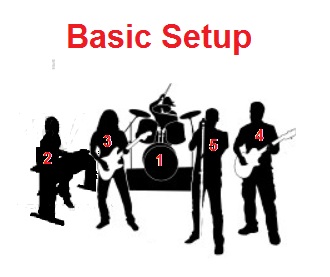
Setting Up the Band 1- The Drummer The drummer should always be the earliest one to arrive. There's a lot of gear to be set up. They are the furthest back on the bandstand and need the most space. Help the drummer establish their area and carry things in for them. It will speed the set-up process greatly. 2- Keyboardist & PA System The keyboards are next, along with a PA system (if your own). The keyboards should alway be set to have a full view of everyone in the band. Most often, the keyboard player is the leader, calling out songs and making adjustments. The keyboard player needs to see everyone. 3- Guitarist The guitar players will need to place their amps in the right spot. Pedals come next. The guitars should always be in the thick of things, downstage. 4- Bass Player The bass player should be the closest one to the drummer. These two are going to drive the band and they need to be in sync with each other. 5- Lead Singer The lead singer is the last one to set up. They are the most mobile and need the least amount of dedicated space. |
 |
|
Follow the Leader Every band needs a leader, a person who will create the setlist, shout out the key, and get the money at the end of the night. It’s usually one person, but the tasks can be broken up into two categories: Business and Creative. Business Leader One of you will need to be a leader and deal with the client, bar owner, maître d, or booking agent. You should decide who the business spokesperson is in order to avoid confusion with things like bookings, money, and start times. Creative Director / Musical Director / Conductor It’s usually the piano player, because they are the most likely to be classically trained. In any case, this person would be responsible for calling the tunes and knowing the arrangements. This person is a music historian, a repository of every song ever written. They know who did it originally and in what key. In short, it’s the piano player |

|
PICKING THE RIGHT KEY FOR THE INSTRUMENT |
|
Playing with other musicians is a joy, but it can also be a challenge. Everyone will have their own level of musicianship. Some will be incredibly talented, able to play any song in any key with ease. Others, however, have limited skills. Instruments, likewise, have limitations. Rather than delve into them too deeply, I've created a chart (above). The top line will tell you what key the instrument is in. "Concert" is another way of saying the key of C. If you play guitar, you know that certain chords are easy to play. C, G, D, A, E are basic chords known to all players. Bar chords like F, Bb, and Eb are more difficult and playing in those keys requires a bit of thought and practice. A horn player prefers F, Bb, and Eb. That's because when a tenor sax player is in the key of Bb, the fingering is in the key of C. Pretty easy stuff. However, when a guitar player calls something in the key of A, the tenor player has to play in the key of
B. That's five sharps, not an easy task even for the best player. By the way, harmonicas are in different keys as well. The harp player will bring a wide array to the gig and change frequently. |
|
DOLLAR STORE KIT |
|
|
-Duct tape -Electrical tape -Needlenose pliers -Screwdriver, Phillips head -Clothespins -Band Aids -3 prong to 2 prong electrical adapter -Short extension cord-Sewing kit -Flashlight |
Backup Musicians have a tendency to want to bring as little as possible to a gig. That’s understandable. You don’t want to have too much equipment exposure. Things get easily get broken or stolen. Even so, you’re going to need to bring some backup equipment. Simply ask yourself: What if this breaks? The Dollar Store Kit is always a good idea. There are ten items on the list. That’s $10.00 that will save your life someday. Sooner or later, something is going to break while onstage and you will need to tape it, screw it, or sew it back together. Or, you may have to chuck it. When that happens, it’s best to have another one handy. This means having extra strings for your guitar. Sax players, please bring extra reeds. Patch cords are cheap, grab a couple from the bargain bin. Bringing two guitars isn’t a bad idea. Bring along the cheap one, leave it in the trunk if you want to. Amplifiers are another story. You can always plug into someone else’s but that’s only in an emergency. If you’re a single, it’s best to bring a small practice amp as a backup. |
|
Black - The Default Color |
|
If you’re not sure what color to buy the guitar in, then buy a black
one. Black is the default color for musicians. You’ll notice that most cases, amps, guitar stands, and music stands
come in basic black.
This is true of any other items you buy for the gig. Don’t get blue pants, buy black. Don’t buy the bright orange electrical extension cord. That’s fine if you are doing yard work. Onstage, it looks terrible. Pay the extra dollar and buy the black one. |
|
|
Using Hand Signals
on the Bandstand The hand signals follow the number of sharps and flats in the song. Sharp keys
are indicated by pointing upward. Flats are pointed downward. The key of "C" is indicated by forming the letter
C with one hand. When the leader wants to modulate upwards, they point up with one finger. A rolling hand tells the band that
we're keeping the song going or taking another ride. The closed fist tells everyone that we're wrapping things up. If it's the last verse, things are going to end quickly, so be ready |

|
|
|
III
|
Comedy
|
|
||||||||||

Most Important Rule of StandUp Comedy:
Be original. Never steal material.
|
Comedians are Writers |
|
|
|
WRITING “People think I’m funny” is the mantra of hundreds of wannabe comics. But being funny isn’t enough. The ability to do funny voices or faces is only good for a few moments. Eventually, the audience will get bored with it. Any fool can jump on a table and be outrageous. Sooner or later, though, the audience wants more. The fact of the matter is that standup comedians are performing writers. Comedians write reams of material in order to hone in on something usable. Out of ten or twenty ideas, maybe one is good. Or, at least you think it is. Something happens when taking it from the page to the audience. It may lose something in the translation. It might kill. You never know for certain. The inflection of your voice, your body language, even the audience itself will play a part in whether it works. It’s best to keep some sort of comedy notebook on hand. Every comic works differently. Milton Berle was famous for keeping everything on note cards and then filing each one according to subject. Today, with the new technology, anything is possible. But Berle’s database system is a good one. It allows for shuffling the order of the material. |
|
|
HACK MATERIAL Hack is comedy material that has been done so many times that it’s no longer fresh, funny, or even interesting. Airline Food, Men vs. Women, New York vs. Los Angeles, Cops eating donuts, and anything having to do with Charlie Sheen or Lindsay Lohan are subjects that have all been beaten into the ground. This list of these subjects changes daily. To be brutally honest here, if you have no understanding of when something becomes hack, then you shouldn’t be in the business. Musicians can get away with doing an entire night of someone else’s material. In comedy, it’s a really bad thing. Never steal anyone else’s material. I repeat: Never steal anyone else’s material. You will be ostracized by the rest of the community. No one will want to work with you. Ever. Protecting against these vermin can be a full time occupation. No matter how many get edged out, others are there to take their place. The best defense is originality. If your act is personal and specific to you, nobody can ever steal it. |


|
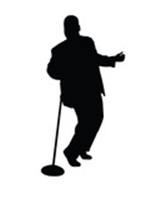
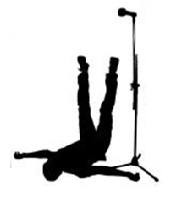
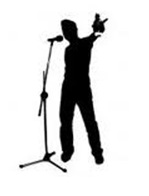
The Three Person Comedy Setup
|

|
Comedy Show Format |
|
1- MC welcomes the crowd and talks up the show. 2- Opener / MC does 10-15 minutes 3- MC makes announcements for the club 4- MC introduces the Feature 5- Feature performs 20-30 minutes. 6- MC immediately introduces the Headliner. 7- Headliner does 30-45 minutes 8- MC thanks the audience. |
SHOWBIZ GLOSSARY
|
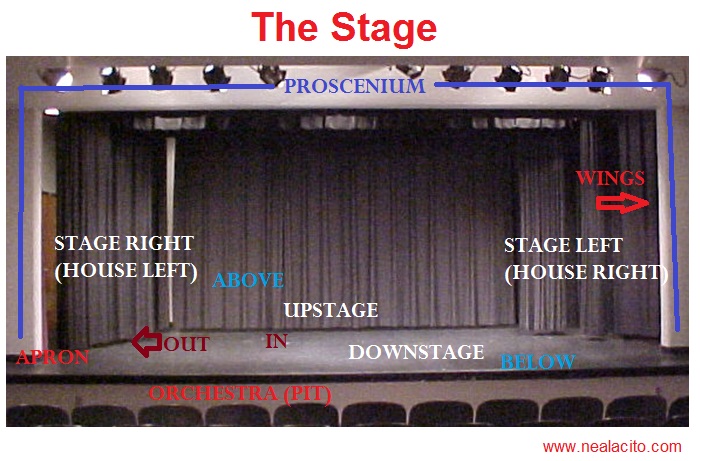
A Above – Away from the audience (Theater) Aca-Poco – Acapella, to sing without musical accompaniment Ad-Lib –
Unscripted material, joke, or music. Improvisation. Aud - Audience Apron – The front part of a stage that juts into the crowd. A&R –
Artists and Repertoire. A record company executive. Ax, Axe - A guitar or other musical instrument.
|
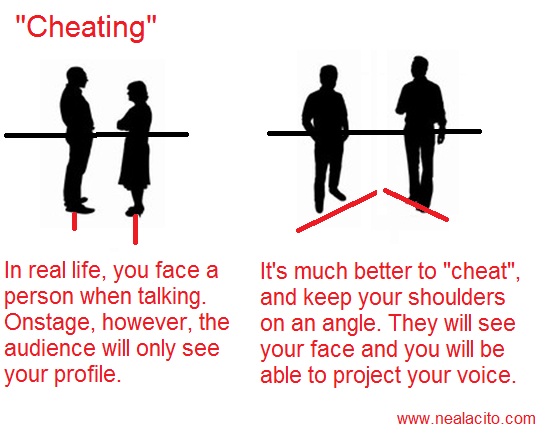
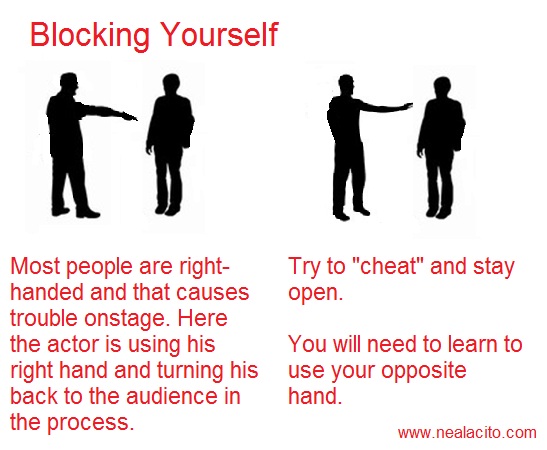
B Beat – 1- A pause (Comedy, Theater) 2- A measured amount of time (Music) Below – Toward the audience (Theater) Bent – A note that rises and falls in pitch. Blocking- Arrangement of actors’ movements on a stage. (Theater) Block Chords – A piano playing style where the player locks hands and plays the same notes on both left and right. Blow – To play a horn or woodwind instrument. Blue Notes – Notes in a scale that are flattened, usually the third and fifth. Blue material – A joke with profanity or sexual reference. Rated R material. Boff, Boffo, Boffola - Outstanding Bomb – 1- To fail. (American) 2- To succeed. (British) Bone – A trombone. Booker – Agency that hires / pays the acts and places them in a venue. Boogie Woogie – Style of blues piano playing with a walking bass part. Box – An upright piano. Break – A sudden stop in the middle of a song. Bridge –
A section of a song that links the chorus and the verse. Butterflies
- Nervousness. "I have butterflies in my stomach".
|
C Callback – 1- A prospective employer literally calls you back for another audition. 2- A reference to a previous joke (Comedy). Call and Response – A musician plays a phrase, another musician “answers” and plays a similar phrase. Capper 1- Final song in a setlist (Music). 2- Final joke in the series (Comedy) . Changes – The chord sequence in a song. Chantoosie – A chanteuse, a female singer Chart - A written arrangement, whether a full score for many instruments or a lead sheet Chirp – To sing. Chops – 1- Proficiency on an instrument (Music). 2- Superior acting skills (Theater). Chord – At least three notes played simultaneously. Chorus – 1- A section of music that repeats at certain intervals. 2- The theme of a piece of music. 3- A group of singers. Cleffer – A songwriter or an arranger. Closed Up – An performer who physically turns away from an audience. Cluster – A group notes that are close together. Usually a dissonant chord. Counterpoint – Several melodic lines playing at once. Counting the House – 1- How much money a production made. 2- Checking an audience before a performance Cross – To move broadly from one part of the stage to another. Cue- 1- The line in a script that is immediately before yours.(Theater) 2- A conductor giving you a sign to perform. (Music)
|
|
D Dissonance - A combination of notes that is heard as harmonically unstable or unpleasant Downbeat- First beat in a measure. Ex. 1-2-3-4… the 1 is the downbeat. Downstage – On stage, close to the audience Drying Up - Forgeting your lines onstage.
|
E Embouchure - The manner in which one must form the mouth in order to play a wind instrument Ensemble – A group of performers who focus on a group dynamic rather than an individual performance. (Theater, Music)
|
F Flop – A failure. Flopsweat – A panic reaction. Flyspecks - Musical notes on a page. Four-Wall – A theater that is available for rent. Fourth Wall – Imaginary wall between the actors and the audience. (Theater)
|
|
G Gag – A joke. Gig – A show business job. Go to Church- A command to sing it in a Gospel style, with improvisation. Going Home - Ending a song with a flourish. Groove – A pattern of music with danceability. A good feeling while playing music.
|
H Hack – Short for hackneyed. Overused material. Head Arrangement – A musical arrangement where each player takes turns playing the melody. Headliner – 1- The star of the show. 2- The last comedian in a show (Comedy) Henscratches - Musical notes on a page. Heckler – A disruptive audience member who engages in a verbal exchange with the act. Hoofer - Dancer House – The area where the audience is seated. Huddle – To have a meeting with an important industry executive.
|
I Improvisation – Spontaneous output of creativity. In – To move to the center of a stage. Ink – To sign a contract In the can – The film or recording is already finished. Ivories – A piano. Keys were once made of ivory.
|
|
J Jam, Jam Session – Informal gathering of musicians playing for fun. Jingle – Short musical phrase used for commercials. Jokey – A comedic criticism indicating that a bit sounds unnatural.
|
K Kill – To do well with an audience. |
L Lay out! - Do not play! (Music) Legit – Legitimate theater. Classical theater. Lick – A practiced phrase that a player puts into a piece of improvisation. Liquorice Stick – A Clarinet Line-up – A list of scheduled acts. |
|
M M.C. – Master of Ceremonies. The announcer who introduces acts. Middle / Middler – The second act in a show line-up. (Comedy). Mitting – An audience applauding. Motivation – The reason a character does what they do. (Theater) Mugging- Exaggerated comedic facial expression. Mute – 1- A device placed in a brass instrument to soften or change the sound. 2- To completely take out a channel on a sound system so it can’t be heard.
|
N Nabe – A neighborhood theater. Nut – Operating expenses that need to be recovered before making a profit.
|
O Off-Beat – A lack of rhythm, odd. One-Liner – A joke made up of only one or two sentences. A short joke One-Nighter – A job that lasts only one night. Open – 1-The starting date of a show. 2- Position of a performer who faces the audience. Open-Mike – A show where acts are able to perform and get stage time. No pay involved, but sometimes it leads to a spot at the club Opener – 1-The first act in a show. 2- The first piece performed in a show. (Music) Out – To move away from the center of a stage. Over-the-top – Going too far with enthusiasm. Outrageous.
|
|
P P&A – Print and advertising. Payola – A bribe to play certain music. Pastiche – A combination of musical styles. Pitch – 1-To propose an idea or project. 2- A musical tone. P.R. – Public relations. Praiser – A publicist or agent. Proscenium – The “frame” around the stage. Punch- A command from the director to perform a line louder and more enthusiastically. Punch it up – Make it funnier. Pump it up – Make it louder Pretzel – A French Horn
|
Q |
R Riff – 1- An improvised solo (Music) 2- Verbal banter with the crowd (Comedy). Routine – 1- Jokes or stories arranged by subject and performed on a regular basis. (Comedy) Roll – 1- A successful run of material. 2- Telling joke after joke without stopping (Comedy) Running Gag – A recurring joke or theme. Runthrough – An uninterrupted rehearsal of an entire scene, routine, play, or set.
|
|
S Scat – A method of improvisation using nonsense sounds and made up words. Schtick – Yiddish word meaning a routine or individual sight gag. Segue – Intermediate step when moving from one song to another or one joke to another. Showcase –An non-paying audition of multiple acts in the guise of a show. Sideman – 1- Member of the band who is not the leader. 2- A non-member of the band brought in for a one-nighter. Sight Gag – A physical joke that needs to be seen to understand it. Sides – Your part only. 1- Music for your instrument only (Music) 2- Your lines, not the entire script (Theater). Splat – A group of notes played with no definitive pitch. Spot – 1- A Spotlight (Theater) . 2- The position of the act in show. 3- Musical notes on a page.(Music) 4- Visual cue on a wall (Dance)Stage Left – The actor’s left while facing the audience. Stage Right – The actor’s right while facing the audience. Stage Time – The amount of time an act is given to perform. Stealing a Scene – Drawing attention to yourself when other (more important) things are happening onstage. Stick- A clarinet. The Sticks – Any venue not in New York City.
|
T The Talent – Any performing artist or group of artists. Terp – A dance or dancer. Short for “Terpsicore”. Thrush – A throaty, female cabaret singer Topper – A similar joke or song that does better than the previous one. Trap Set – A drum set. Tuner – A Broadway musical
|
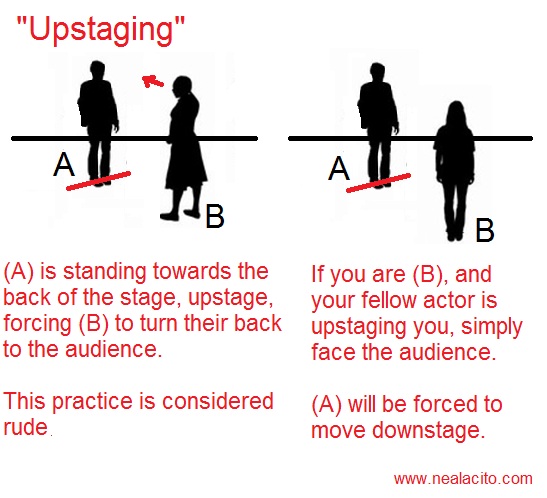
U Upstage – 1- The area towards the back of a stage, away from the audience.2 – To rudely stand towards the back, forcing a fellow performer to face you instead of the audience.
|
|
V Vamp – Repeating the introduction of a song over and over, waiting for the soloist to start. Venue – The location of the gig. Voiceover – Off screen narration for film or commercials. |
W Waiting in the Wings – 1-Waiting to make an entrance 2- Eager to take over a part. Wallpaper – Music being played at a venue that’s meant to blend in and add ambience. Warbler – A less than talented singer. Wrap – To finish a project. Wings – Area where a performer waits to enter the stage. Working Blue – Using adult language and content.
|
XYZ Yawner – A boring show or set. |
|
|
|
Enter supporting content here |